
ASA Structure
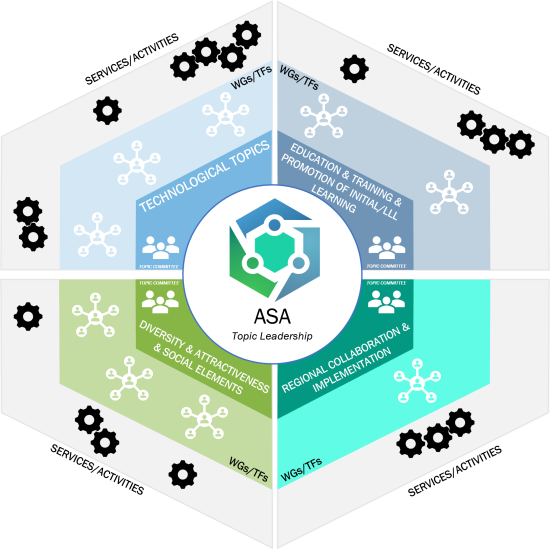
- The ASA was announced and officially launched in November 2020
- The ASA became a legal entity (non-profit organization) in January 2022
- Based on the Flamenco project methodology and recommendations, internal organisation of ASA was re-structured in March 2024
Topic Committees
TECHNOLOGICAL TOPICS
ASA Secretariat: Marek SPANYIK
Members:
Marek Spanyik; Didier Stevens
Damjan Ekert; Georg Macher
David Decerf; Josef Tichánek
Marius Tudor; Daniel Gaspar
Bogdan Mihailescu, Paul Svasta,
Cristina Lepadatu
EDUCATION TOPICS
ASA Secretariat: Marek SPANYIK
Members:
Marek Spanyik; Didier Stevens;
Damjan Ekert; Georg Macher;
David Decerf; Josef Tichánek;
Marius Tudor; Daniel Gaspar;
Gabriella Mihályi, Bogdan Mihailescu,
Cristina Lepadatu, Paul Svasta
SOCIAL ASPECTS
ASA Secretariat: Michaela PALASOVA
Members:
Michaela Palasova
Didier Stevens
Daniel Gaspar
Marius Tudor
REGIONAL DIMENSION
ASA Secretariat: Michaela PALASOVA
Members:
Michaela Palasova
Didier Stevens
Daniel Gaspar
Marius Tudor
The Automotive Skills Alliance is composed of four individual Topic Committees which are coordinated by the ASA Office:
- Technology – The Technology Committee prioritizes Repair and Maintenance, Batteries, Hydrogen, Digitalisation, Electronics Packaging, Software/System Development, Life Cycle Assessment (LCA), and Environmental Footprint. With a focus on extending device lifespan and minimizing electronic waste, the committee explores sustainable energy solutions, integrates digital technologies, and evaluates environmental impacts for a holistic and sustainable technological approach.
- Education – The Education Committee focuses on advancing learning through effective programs, training, and the promotion of both initial and life-long learning. By prioritizing continuous education, the committee aims to equip individuals with the skills needed to thrive in an ever-changing world.
- Social Aspects – The Social Aspects Committee prioritizes diversity, attractiveness, and key social elements. Committed to inclusivity, it actively promotes diversity and works towards enhancing social appeal and engagement. The committee focuses on creating a harmonious and inclusive society that values diversity for a vibrant and enriching social environment.
- Regional Dimension – The Regional Dimension Committee prioritizes regional collaboration and effective implementation, fostering collective efforts to address shared challenges. Emphasizing collaborative strategies, the committee aims to create a resilient regional framework for sustainable solutions benefiting local communities.
Topic Committees are responsible for the evaluating, steering, and recommendation provision to specfic Groups which are present under each Committee area, thus steering the ASA activities in specific areas. The structure of Groups and Committees combines, in principle, a horizontal and vertical approach. Groups are of a vertical nature and ASA member types groups represent a horizontal perspective (involving industry, education/training providers, social partners, regions, and more). Each group has clearly defined working plan and may be permanent (working group) or temporary (task force). Groups may use the guidance of developed methodology to select various activities which may be executed to improve the European Skills Intelligence.
- Members of ASA participate in groups or may establish various groups.
- Topic Committees recommend and steer the activities of the groups.
- Each group works on specific selected activities in the context of the European Skills Intelligence.
Working Groups and Task Forces

Permanent (Working Group): These are long-term WGs that address ongoing or core issues within the automotive sector.
Temporary (Task Force): These WGs are set up for a specific duration to address immediate or short-term challenges or projects.
ASA Members have an opportunity to become part of specific Groups or to establish a working group/s by clicking the buttons below.
Note that the following structure and methodology improvement was developed thanks to the ERASMUS+ funded project FLAMENCO, thus views and opinions expressed are however those of the author(s) only and do not necessarily reflect those of the European Union or the European Education and Culture Executive Agency (EACEA). Neither the European Union nor EACEA can be held responsible for them.